
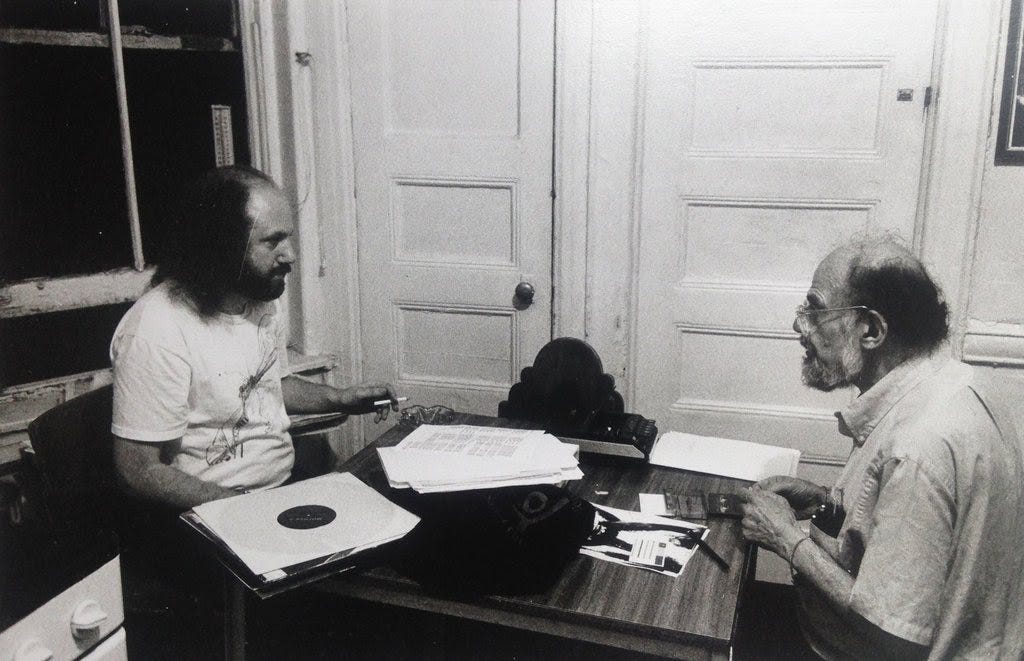
June 26, 1993, Morning Session, Allen Ginsberg’s apartment, NYC, NY
AG: And Barbara [Rubin] was a girlfriend of mine and was one of the early enthusiasts for the Beatles. One of the earliest of the American Beatle fans. In fact, when they played at the Paramount for the first time, she went and put out handbills.
HW: They played the Paramount in Brooklyn? Or the Paramount in Broadway?
AG: No, the Broadway. And she’s also visible on the back of the Bob Dylan album in a striped sweatshirt, giving him a scalp massage.
HW: The Bringing It All Back Home record?
AG: I guess so. Yeah. The one where I’m in a top hat.
HW: Right.
AG: She was my girlfriend at the time. So we were all in London [at] the time of Don’t Look Back and Dylan’s concert at Albert Hall and got inspired to organize a big poetry reading.
* * *
AG: Yeah, and so the method of composition [for the poems in Ginsberg’s Fall of America]: I had a Uher [tape recorder] which Bob Dylan had given me money for around that time in San Francisco—around the time of the Hell’s Angels and the San Francisco anti-war marches. Dylan had come to town and given a bunch of concerts in Berkeley and San Francisco, and we negotiated with the anti-war people to have Dylan lead an anti-war march. And he said, yeah, he would do it if they would cooperate with his aesthetics, which was to have a giant assembly of people, and he would provide trucks and posters of giant oranges, lemons, bananas, and they would carry those around and not make any speeches, and assemble thousands [of] people, and that would clog San Francisco. And Jerry Rubin didn’t understand it and thought this wasn’t political enough. So they left. Failed to pick up on Dylan’s extraordinary insight. So at that time I was seeing a lot of him, and he gave me a whole bunch of tickets to invite the Hells Angels to his concert and all the poets in San Francisco, and he also gave me $150.00 to buy a Uher tape machine, which I still have. The first use of which was to tape his concert in an auditorium. And then I had this Volkswagen....
HW: That’s not during the period ... did he have a band? Was he touring with the band at the time?
AG: Yeah. Sixty-five. During the Band [tour]. And Joan Baez was visiting at the time, also.[1]
* * *
AG: My idea with the section [of “Wichita Vortex Sutra”] which climaxes with “I hereby declare the end of the war” is echoed earlier. [President Lyndon] Johnson was broadcasting for the moment, and I was broadcasting for a longer time in my poetry. They were making public statements that would be vanished or obsolete within a year or two, and that I was speaking for long ranges—for hundreds of years. That the war was, to begin with, never declared until it was illegal, so it was just a whim of the governors. But we were the people, and I was one of the people, and as a citizen I had my whims, too, or my direction of will different from theirs, so if they had the chutzpah or nerve to conduct a war that they didn’t legally declare, I had the nerve and the will to say, “I undeclare it.” And actually John Lennon and Yoko Ono did something very similar later, with this giant billboard over Times Square, “The War Is Over, If You Want It.” At the time, and later, I’ve seen criticism of this, that [it’s] fatuous romanticism: “He declares the end of the war and the war doesn’t end.” Well, naturally it doesn’t end. Diane di Prima says, “The Great War is the war on the imagination.” Who controls the language, who controls the U.S. imagination?
So I’m setting up a daydream to counter the daydream of the governors, or the nightmare of the governors, that will inspire other people to realize that they are free to declare the end of the war as far as their personal part is concerned, and they don’t have to be intimidated into supporting the war effort, because the war is wrong. And that in a democracy, the opinion of the individual and the actual citizen is equal to the opinion of the president, according to Whitman and Dylan: “Even the President of the United States must some day stand naked”; and Whitman saying, “I wear my hat indoors as well as out, and as an individual I’m just as equal to any pompous politicians.”
* * *
AG: It turns out [Harry Smith] was a musicologist, and then he showed me this set of American Folk Music—six records, [a] three-box set he put out way back in 1952, which was ...
HW: Folkways.
AG: ... on Folkways. He [did] ethnomusicology studies here in America. He went all over the South buying up old records and collecting these blues, and apparently this box set was a historic bomb in American folk music because it turned on Peter, Paul and Mary, turned on the whole folk music world at that time, including Ramblin’ Jack Elliott and everyone else, because it was this treasure of American blues [and] mountain musics. Happy Traum, everybody, including Dylan, [was] affected by it up to Jerry Garcia, who learned blues from Harry Smith’s records, according to Garcia.
* * *
I guess I was inspired to music, as I said, by first mantra chanting, then setting Blake, then Dylan put his hand in and got me interested.
* * *
I don’t know where I first met Hammond. Through Dylan [maybe]. And I’m not quite sure how all that started. But I knew of him before, and he knew of me, maybe, more through political Left Black Liberation and stuff, or maybe I met him at an NAACP dinner that I was taken to by Jerry Wexler in the ‘60s. And then, of course, he was historically connected with Dylan, and I had written a lot of tunes in ‘71, and then I was on the road in the [Rolling] Thunder tour, and I must have met him again through there. I’m trying to remember, but I really don’t, where it began. But I remember I started going up to see him, maybe with the Blake record originally—the second Blake album—or, oh, I know, I must have gone up to see him originally with the Dylan tapes that I’d done in 1971. And also with my unissued Blake album. So this may have been before Rolling Thunder tour or right after. We got together more intensively, and I used to visit him every once in a while, and he was interested and made time to talk to me, actually.
* * *
[During my recordings for John Hammond], at least I could carry a tune, and I could sing, and I had my words straight, and the musicians seemed to know what they were doing. I think [Hammond] might have even been surprised that I had it that much together, because I don’t think there were too many poets who did have it together like that. But obviously Leonard Cohen and Dylan. By that time they’d really had it together. I was just sort of coming in late.
* * *
Even though I was frustrated and couldn’t get Volume II of Blake out and never was able to put out the Dylan tapes—I never was able to get help from Albert Grossman to do anything—and maybe it wasn’t worth it at the time, I persisted.
* * *
AG: I had the old Dylan sessions to deal with so we decided to make a double album, include three of the cuts from the early Dylan, ‘71, our choice of the Hammond material, which is 40 minutes or so, and then what I produced at ZBS with Jon Sholle as a session leader.
HW: It came out as First Blues.
AG: And selected as First Blues. Very luxuriously done, with a newspaper inside giving all the chording notes and the essays and a little statement and a little essay by me and the words. A little newspaper like a tabloid, plus interior and exterior photography, arrangement by Robert Frank, who did it very expensively. It got some really nice reviews, and then sank into oblivion.
* * *
AG: I can be said to be John Hammond’s last discovery among blues singers. I was lucky.
HW: When did he pass away?
AG: Oh, I stayed in touch with him till his deathbed, actually. I don’t know when it was [July 10, 1987] but last time I saw him was about a month before he died. I went to visit him in his house on 57th Street, and I’d just seen Dylan, so maybe it was ... I don’t know. It wouldn’t have been ‘82, would it? I don’t know. And I’d been listening to a lot of blues—probably around ‘85-‘86—and Dylan had said Robert Johnson’s the only one. I said, “What about Charlie Patton?” He said, “Charlie Patton is very great. They’re all great. But Robert Johnson is the one.” So then I went to see Hammond and repeated the conversation and said that Dylan said that Robert Johnson is the one, the greatest. And he said, “He’s right.” So they had some kind of secret understanding of music.
[1] Dylan with the Band appeared at the Masonic Auditorium on December 5, 1965. Allen’s recording is part of Stanford’s collection.
Most excellent!
AG brags about his line that declares the end of the Vietnam War-Too bad he never saw the Julia Vinograd poem "Allen Ginsberg" that's been printed here at the AG website -that shows the disastrous consequences of that declaration for at least one person. But -overall to a greater extent -"rhymes" with Ferlinghetti's remarks to the effect that fame -and particularly seeking out Rock musicians -hurt Ginsberg's Poetry - but also swelled AG's ego beyond any recognizably human bounds - despite all the guru-ing and chanting -in a way that Mick Jagger oddly enough illuminated in his recent interview where he discusses the distorting effects of Fame that AG ,I think ,lost sight of -until he came to Brooklyn College and also published some great poems in White Shroud ,and after -His later work, largely ,I believe escaped the trap of Fame that had ensnared him for a long period after Kaddish...