
When Allen set out to create notes to accompany Holy Soul Jelly Roll: Poems and Songs 1949–1993, he knew he’d never have a better chance to document his work than with Hal Willner—who was interested in and informed about Allen’s extremely niche musical areas of note—and often went on extended digressions—especially on Harry Smith and Bob Dylan—partially, I believe, because of Hal’s obvious delight, and partly to preserve his stories.
Allen despaired at the thought of sitting down to write notes for 4 CDs of performances over nearly 50 years—so much historical context was necessary—so he suggested Hal interview him to get what they needed. They recorded 10 hours of conversation over three sittings, going through each track, from first to last.
As his transcriptionist for the last seven years of his life, I was responsible for bringing anything of note to his attention. After I edited the 1000 pages into the booklet’s text—Rhino wouldn’t read anything longer than 56 pages—I had material left over for several monographs, one of which I called Ginsberg on Dylan. I thought a collection of Allen’s Dylan stories would make a nice “archival” monograph or a feature in any Dylan fanzine, with little effort and an introduction from Allen. I included every mention in his classroom lectures from 1974-1983, his 1975 Rolling Thunder Revue notes, and anything I transcribed from his journals from 1978-1979, all of which I’d been collecting since I began transcribing for him in 1980.
I’ll be publishing a selection of these unedited, mostly unpublished excerpts over the next three Fridays from the original “assembly edit,” which includes every mention, because a slight reference can become very important in another context.
All commentary is from Allen unless as noted.
Session I: June 9, 1993, Allen’s kitchen, NYC, NY.
AG: So there was a big era of good feeling [in the late Fifties in NYC] between Black and White poets and a big meeting of cultures where Leroi Jones [Amiri Baraka] would have parties with Cecil Taylor and Ornette Coleman and Don Cherry, Franz Kline, Frank O’Hara, Kerouac, myself, Corso, Langston Hughes there at those parties. I met Langston Hughes once. Then there was a big reading at the Gaslight [Cafe] that got on the front page of The Daily News—the first big coffeeshop poetry reading that finally attracted Dylan to the Gaslight.
* * *
Earlier that year [1957], I had been to Ray Bremser’s apartment. Bremser’s a poet who’s full of jazz and Dylan liked it. A spoken, speaking poet or a jazzy poet. Dylan mentions him on the back of one of his early album covers [The Times They Are A-Changin’].
* * *
It’s [Atlantic Records’ recording of “Kaddish” in 1966] that apparently moved Dylan also, this recording, when he heard it. He kept telling me that was the thing that really turned him on to my poetry, inspired him.
* * *
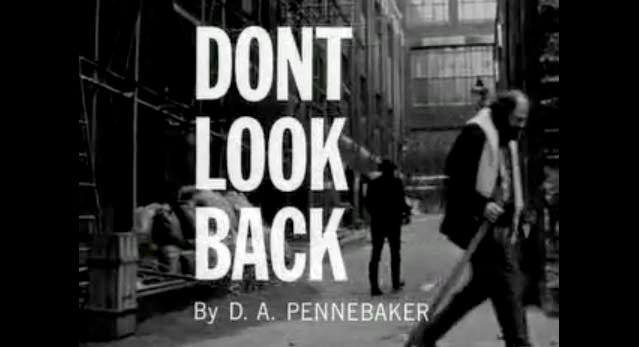
What’s interesting is that having been kicked out of Czechoslovakia for suggesting that they invite the Beatles as a grand propaganda move to win the youth of the world; having been kicked out of Cuba for that and for criticizing Castro on gay issues in private; having been through Czechoslovakia and Russia and Poland and back through Czechoslovakia and actually elected May King on May 1st and then expelled from the country on May 7th; by May 9th or so I was visiting with Dylan on the Thames Embankment where he was making Don’t Look Back—in that first scene of “Subterranean Homesick Blues”—and within a few days was in a room with him and [I] was escorting Marianne Faithful to the Dylan concert at Albert Hall and then winding up alone in a room with the Beatles and Dylan. So that it was a very funny transition. I really was the King of May.
HW: Where was the “Subterranean Homesick Blues” filmed? That was in London?
AG: It was in London at the embankment of the Thames by the hotel they were staying in, which was the Croyden or something. And I was talking about him with Victor Maimudes outside, unless I’m mistaken. We were just hanging in the background. We just wanted to be in the background as an audience for him.
HW: Walking across at the end.
* * *
“Many Loves” is a curious interlude in a larger recording session. The idea of this session with Dylan and [David] Amram and others was to improvise in the studio [in 1971]. The idea also was to have Apple Records put it out. And we had an agreement between Dylan and John Lennon and myself that this would happen.
HW: So this was improvised, “Many Loves”?
AG: It was totally improvised on the spot. [Happy] Traum and Dylan were twiddling around, and we got that kind of interesting long run, and then I began sort of vocally raising my voice in a kind of tired way at one point or other, trying to think of something to say, embarrassed, you know, [and] embarrassingly [I] began talking about real people. But it’s actually a piece of real improvisation, and it has a little bit of rhyme. Trails off in a funny way, but it’s complete. I mixed it myself, but not very successfully, but then I didn’t think it was....
HW: No, it wasn’t. Because I had not heard your mix when we mixed it, and ours wasn’t much different. You actually did a lot more with stereo separation. You used Peter’s voice in a different ... one speaker to the next. So we do have a second [mix on this release]. I want to talk about how this session evolved. So you had made a deal to do an album for Apple Records.
AG: No, what happened was this. I had already sold the [recordings] of the sixteen volumes of poetry—[my] collected poetry assembled, plus an album I did out West at Pacific High [Recorders Studio], of [William] Blake, Volume II—and had a contract with Fantasy [Records]. And I got back to New York, and Peter and I had a reading at the Loeb Student Center at NYU. By this time, I was interested in music more because I’d had several albums behind me—the two Blake albums and had finished the 16-volume set—so I invited all the musicians I could think of to come assemble at the Loeb Center, so we had about 15 musicians. Friends. Jon Sholle among them, who had been playing with me for a long time and was on both of the Blake albums, who turned out to be a great friend and a great guitarist and very intelligent, very sensible and supportive. He was my main musician for many, many years.
HW: And his main instrument was?
AG: Guitar.
HW: And he was involved in this Dylan session.
AG: Yeah. He was also on both Blake albums and the Dylan session, and later the [John] Hammond sessions [for Ginsberg’s 2LP set First Blues].
HW: So it was arranged for Apple.
AG: Now, so wait a minute. Dylan came to the reading ...
HW: At the Loeb Center.
AG: ... at the Loeb Center with Dave Amram and stood in the back, so I didn’t know he was there. And Peter was beginning to do a lot of improvisation, and he had the idea that you shouldn’t write poetry down, you should sing it in the air because if you write it down, you have paper, and that cuts down trees. So he began a long improvisation on that, and then I picked up on it, and we spent maybe a half an hour before this giant audience—this whole hall filled—making up words on the spot with the musicians. Now, I didn’t have the form of the blues in mind, because I didn’t know how to do it, so it was just a freeform, rhyming, sometimes extravaganza. Then the reading was over and we packed up and said goodbye to the musicians and thanked them and gave them a little money I think and then went home and then the phone rang.
HW: At the Loeb Student Center you had Jon Sholle.
AG: Jon Sholle.
HW: Right.
AG: And I don’t know who else. I don’t remember who else. Friends of his. Maybe. Gee, I forgot.
HW: Okay, we’ll find out.
AG: Well, I don’t know if we can.
HW: Jon Sholle is still around.
AG: Jon Sholle was there, yeah. I got in touch with him. So it was Dylan on the phone saying that he had come to hear the reading, and he was standing in the back with Amram, and he said [on the phone], “Do you always improvise like that?” And I said, “Not always, but I can. I used to do that with Kerouac under the Brooklyn Bridge all the time.” And he said, “Oh, we ought to get together in a studio and do it. What are you doing now?” And I said, “Oh, I’m just here with Peter.” And he said, “Well, we’re coming over.” So he and Amram showed up. And I think Peter had a guitar, or somebody had a guitar, or maybe they brought a guitar and they wanted to see what I could do, and he started playing something that later turned out to be “Going Down to Puerto Rico,” which I later learned was the same chords as “Like a Rolling Stone.”
HW: Which was also “Vomit Express.”
AG: Oh, I’m sorry, “Vomit Express.” Yeah, that’s “Going down to Puerto Rico, going on the Vomit Express.” “Vomit Express” begins
I’m going down to Puerto Rico
I’m going down on the midnite plane
I’m going down on the Vomit Express
I’m going down with my suitcase pain
AG: So we began improvising there, and he enjoyed it, and he saw that we were having a ball, and at the same time I was amazed because I didn’t get to see him very often, though we’d been a little closer maybe five years earlier in London. I’d seen him on and off. I’d visited him when he was laid up with his motorcycle accident. And seen him in San Francisco in the mid-60s. So then I had a harmonium in the other room, and so I was showing him how I played, I guess, certain mantras, but I only knew two chords at that time, so he said, “Well, you know there’s three chords.” So he began showing me a third chord.
* * *
I was writing this poem [“Stanzas: Written at Night in Radio City”] which was a kind of renunciation of money, sort of a caustic comment on sex, on the megalopolis, the stone buildings, on the disdain that people held for art, which was our pure thought, a funny put-down of dope hippies
The city’s hipper slickers shine,
Up in the attics with the bats
I.e., they’re all crazy with their poppies, fame being a temptation and a line kind of prophetic of Bob Dylan I always thought:
May boys amaze the world to arm,
Yet their charms are changed again.
And fearful heroes turn to harm;
But a shambles is a sham.
A few angels on a farm
Fare more fancy with their lamb.
* * *
That poem [“Stanzas: Written at Night in Radio City ”] has an interesting history. It was from the [manuscript] called “The Gates of Wrath,” which I had given to Mark Van Doren’s son, and he took it to England, and it got lost for many years till after Howl had come out, and one day, talking to Dylan in around 1964, he said when he was in England someone had given him a book of something that was supposed to be my poetry.
HW: Original manuscripts.
AG: The original manuscript, typescript of it, which I didn’t have. I had little fragments of it, but I didn’t have a complete typescript because, in those days, naively thinking it might be published in England if not in America, I’d given it to Van Doren’s son, who was going to England. So this manuscript, including this poem, was returned to me by Dylan.
HW: So this book [The Gates of Wrath] is basically, within five years, your earliest poems.
AG: Yeah.
HW: Five years that were all lost for a while.
AG: Yes. Lost till about the early ‘60s—probably between ‘53 and ‘63.
HW: And you don’t know who [had them]? It just ended up in Dylan’s hands.
AG: Somebody gave it to Dylan [and] said, “You’re a friend of Allen Ginsberg, alright, I got these nice poems you’ll want to see.” Dylan liked them actually, I think. Though it seemed to me they were so way far behind his updated song rhythms.
* * *
AG: On those early readings [of Ginsberg reading from the late 1940s], it’s actually sort of … the voice sounds harsh, like Kerouac’s voice during those years, at that time, which is not so much like the dreamy and poetical and sort of in a trance. Certainly not updated to vernacular jocundity and vivacity, which is something that I learned from both Kerouac later and Dylan, but mostly William Carlos Williams.
* * *
HW: No, actually you didn’t say what happened with Apple [in 1971].
AG: Well, [Barry] Miles had done some stuff with Apple with Apple money. [He] had recorded Charles Olson and a few other people to put out on Apple Records. Miles was going to do [Apple’s] spoken word series, and was capable of doing it and did historically important recordings of Olson. And [our record] was part of that larger thing, and Peter Asher was part of the encouraging group. But then I don’t know. Let’s see. What happened then? Yeah. [This] was also around the time of the Dylan sessions, and that was definitely for Apple because [of the] Dylan [connection]. Dylan had talked with Lennon, and Lennon had definitely said yes. Years later I learned from Lennon what happened. I’d been in touch with Lennon and Yoko Ono during that “Give Peace a Chance” time, you know, he used my name. Strom Thurmond, the senator, had started a vendetta against Lennon, trying to get him kicked out of the country. And Yoko Ono called me up as sort of a political advisor, [asking me] what to do, and I went to see Allen Klein [and] talked to him about it and recommended lawyers in Washington that I worked with—[William] Kuntsler and other people, because I’d had some legal dealings. I had succeeded in beating the State Department to go to Cuba in 1965 by threatening a suit. So I thought Ed Degrazia, the Grove Press lawyer who defended Naked Lunch and Henry Miller and gotten me my visa to Cuba would be able to help, plus other people.
So it was arranged that Apple would put out this Ginsberg-Dylan combo. But what Lennon told me later was that he wanted to quit with Klein, and he had to do it in a cut-throat way like Klein, so they had to, very secretly, make all these preparations, make all the legal moves secretly and get other lawyers and all that and get everything ready to pull the trap on Klein so he was not able to tell anyone, including me.
Meanwhile, I had invested about $15,000 in the Record Plant sessions. In fact, I wasn’t able to pay for it all. It took me another three or four years to raise the money to pay for that. I owed them. And they were giving it to me on credit because Dylan was there. I gave them $5,000. Dylan was there, and Dylan said it was for Apple, so they thought it was all in the bag, so they weren’t worried about getting their money, and it was really a total disillusionment. But I think it was a good thing, because I don’t think at the time that we got a full album [recorded] that was good enough.
* * *
HW: So then [in 1971] you had recorded “A Dream” and “Spring” on that, so we just used the versions that were done. How did Dylan respond to the [William] Blake songs?
AG: The Blake album?
HW: No, the Blake songs, because you had him play on a few.
AG: He played along.
HW: He’s laughing a lot through “Spring.”
AG: Yeah, because “Spring” and some of the Blake were among the few things that I had a definite idea what I wanted. I didn’t know how to do it properly, and I wished he’d taken over and sort of been the session leader. But he was giving me too much head, sort of, too much liberty in a way, and the whole recording session was chaotic, because millions of people were pouring into the studio at the idea of Dylan playing. [Andrei] Voznesensky was there and [John] Coltrane’s wife, [Alice], and Gregory [Corso] jumping in the middle. So at least I had the tunes and the words ready for that. But the idea on these sessions actually [was] to go in without tunes and words and to improvise something. So I was a little overeager to get him to play Blake and to get him to do some mantras. He balked on the mantras quite a bit, because I think he thought it was a mind-trap of some sort.
Ray Bremser - "Turnpike"!
I’m so curious about their relationship. Thank you for sharing this.